


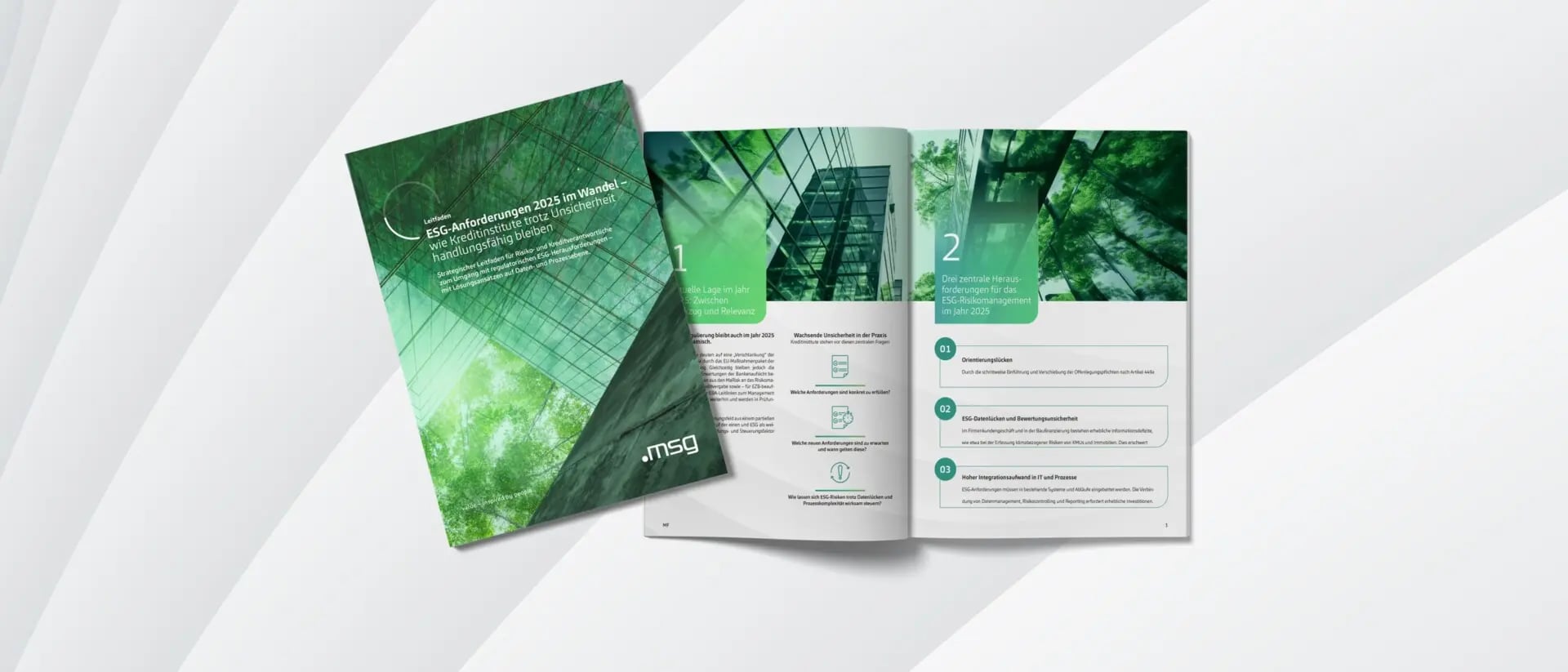










Volatile ESG requirements are causing growing uncertainty for banks
While political signals from Brussels point to a „streamlining“ of ESG regulation – for example through the EU Omnibus Regulation package of measures – the EU continues to adhere to regulations on sustainable corporate governance.
Even if the EU omnibus package provides for simplifications in sustainability reporting, the core requirements under banking supervisory law remain in place."
This means that banks must continue to meet the requirements of MaRisk for risk management and lending and – for ECB-supervised institutions – the EBA guidelines on the management of ESG risks.
Banks caught between relief and the status quo
In this area of tension between partial regulatory relief on the one hand and existing ESG regulation as a continued central audit and control factor on the other, banks are faced with these central questions:
- Which requirements must be met in concrete terms?
- What new requirements are to be expected and when will they apply?
- How can ESG risks be managed effectively despite data gaps and process complexity?
- How can credit institutions remain capable of acting despite the uncertainty surrounding ESG requirements?

Stay ahead of changing regulations
and provides step‑by‑step solutions for data
and process integration.
Log in or register now on BANKING.VISION!
Changing ESG requirements in 2025
In a comprehensive Q&A, our experts analyze what banks will need to know in 2025 (and beyond) – in a concise and practical way.
ESG passivity harbors considerable risks."
They answer questions such as:
- Has the topic of ESG become less important in regulatory terms in 2025?
- What relief will actually apply?
- Why are physical climate risks a top risk factor for banks in 2025?
- How can ESG be used as a strategic differentiating factor despite regulatory uncertainty?
and many more.
Table of contents
- Current situation in 2025: Between retreat and relevance
- Three key challenges for ESG risk management in 2025
- FAQs for decision-makers: What banks need to know in 2025
- Infographic: From ESG risk to a robust basis for decision-making – in three steps with msg.CST